
RPSC Veterinary Officer Syllabus 2025: The Rajasthan Public Service Commission has released the RPSC Veterinary officer syllabus 2026 for 1100 posts. The RPSC Veterinary officer recruitment 2026 is a great opportunity for candidates with a degree in veterinary science.
To Succeed in this competitive exam, candidates must have a clear understanding of the latest syllabus and exam pattern. In this article, you will find the complete RPSC Veterinary officer syllabus 2026, along with subject wise topics and preparation tips.
Also: SSC GD Constable 2026 Exam Date Out
RPSC Veterinary Officer Syllabus 2025: Important Date
| Event | Date |
| Application Start Date | 5 August 2025 |
| Last Date to Apply | 3 September 2025 |
| Exam Date | 19 April 2026 |
Candidates should ensure they submit their application before the deadline to avoid last minutes issues.
Also: MP Police Constable 2025 Final Result
Selection Process
The Selection Process for Chandigarh Administration Clerk & Steno-Typist Recruitment 2026 includes several stages:
- Written Examination (CBT)- Objective type question covering General Knowledge of Rajasthan, Concerned Subject
- Document Verification
- Medical Examination- Final Stage to ensure the candidates is medically fit.
Candidates must qualify in each stage to be considered for final selection.
RPSC Veterinary Officer Syllabus
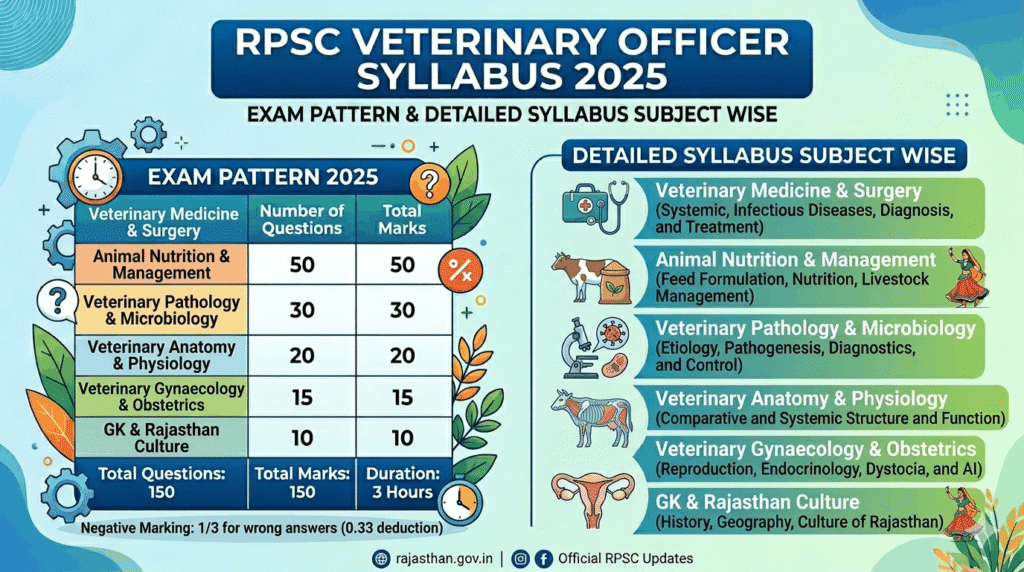
The Written Examination is conducted in an offline mode (OMR based). All question are objective type.
| S.no. | Subject | No. of Question | Total Marks | Time Duration |
| Part A | General Knowledge of Rajasthan | 40 | 40 | 2 Hours & 30 Minutes |
| Part B | Concerned Subject | 110 | 110 | |
| total | 150 | 150 |
Negative Marking shall be applicable in the evaluation of answers. For every wrong answer 1/3 prescribed for that particular question shall be deducted.
RPSC Veterinary Officer Syllabus 2025 (Subject Wise)
Part A: General Knowledge of Rajasthan
Language & Literature: Dialects of Rajasthani language, literature of Rajasthani language and folk literature. Religious Life: Religious communities, saints and sects in Rajasthan. Folk deities of Rajasthan Performing Art: Classical music and classical dance, folk music & Instruments; folk dances & drama. Visual Art: Handicrafts of Rajasthan, Historical architecture- Forts, palaces and temples. Tradition: Costume and ornaments, social customs of Rajasthan. Festival and Fairs in Rajasthan. Various tribes and their customs. Historical sites and tourist places.
Geography of Rajasthan: Broad physical features- Mountains, Plateaus, Plains & Desert; major rivers and lakes; Climate, Major soil types and distribution; Major forest types and distribution; Demographic characteristics; Dairy farming, Desertification, Droughts & Floods, Deforestation.
Inhabitation and home tract of different breeds of livestock in Rajasthan. Animal fairs of Rajasthan. Common wild life species found in Rajasthan and places for their conservation.
Part B: Concerned Subject
Unit II: Structure and classification of bones, joints and muscles. Gross anatomy, topography and histology of different organs of digestive, respiratory, urogenital, endocrine, cardiovascular, nervous systems of domestic animals and fowl. Study of basic tissues i.e. epithelial, connective, muscular and nervous tissues, blood and bone marrow. Introduction to embryology. Different germs layers and their derivatives. Development of organs of various systems and sense organs.
Unit III: Formation and physiological functions of blood. Cardiac cycle. Physiological characteristics of mono gastric and poly gastric digestive system. Physiology of respiration in animals and birds. Regulation of growth. Thermoregulation in farm animals and birds. Structure of biological
membranes and transport across membranes. Enzymes. Carbohydrate, fat and protein metabolism. Ammonia transport and urea cycle.
Unit IV: Introduction, classification, nomenclature and general properties of bacteria, viruses and fungi. Pathogenicity, virulence, bacteraemia, septicaemia and toxaemia. bacterial genetics, Plasmids and antibiotic resistance. Isolation, growth, morphological, cultural, biochemical and antigenic characteristics and diseases of various bacteria, viruses and fungi in livestock and poultry. Basic concepts of Recombinant DNA Technology, molecular and biotechnological techniques. History of Immunology, Types of Immunity, Antigens, Antibody. Serology reactions, Complement system, Cytokines, Hypersensitivity, Autoimmunity, Immunotolerance.
Unit V: Introduction, causes of disease, mechanism of cell injury, cellular degenerations, haemodynamic disorders, disturbances of growth, pigmentations. Inflammation, classification, various cell types and their functions, chemical mediators, cardinal signs, systemic effects. wound
healing. Pathology of autoimmune diseases. General characteristics and classification of neoplasms. Post-mortem techniques, Post-mortem changes, collection, preservation and dispatch of morbid materials for diagnosis. Haematology, anticoagulants, interpretations of blood tests,
urinalysis, biopsy, cytology. Pathology of diseases affecting various systems. Pathology of various bacterial, viral, fungal, mycoplasmal, parasitic and prion diseases of animals and poultry.
Pathological changes in nutritional and metabolic diseases and heavy metal toxicities. Pathology of important diseases of laboratory and wild animals.
Unit VI: Parasites of domestic animals, poultry and wild animals (morphology, taxonomy, biology, life cycles, host–parasite interactions, epidemiology, pathogenesis, zoonotic importance, diagnosis, management and integrated control measures), protozoa, helminths (trematodes, cestodes, nematodes) and arthropods of veterinary importance. Immunity against parasitic infections and infestations, antiparasitic drug resistance. Collection, preservation and examination of parasitic specimens from animals and the environment, preparation of smears, faecal examination, larval culture and identification of eggs, larvae, adult worms and arthropods using microscopic, serological and molecular techniques, integrated parasite management in livestock and companion animals.
Unit VII: General Pharmacology (drug sources, nomenclature, Pharmacokinetics, pharmacodynamics, adverse drug reactions, drug interactions), autacoids, drugs acting on the autonomic, somatic, central nervous systems, and various body systems (digestive, cardiovascular, respiratory, urogenital, endocrine, and skin). Veterinary Chemotherapy (antibacterials, anthelmintics, antifungals, antivirals, antitubercular drugs, anticancer agents, antiprotozoals, ectoparasiticides, antiseptics, disinfectants), indigenous medicinal plants, Veterinary Toxicology (classification of toxicants, diagnosis and treatment of poisoning, toxicity from metals, plants, agrochemicals, drugs, fungal/bacterial/plant/ animal toxins, venoms, food additives, residues of drugs and agrochemicals, environmental pollutants, and radiation hazards).
Preparation Tips
To prepare effectively for the RPSC Veterinary officer exam.
- Cover the complete B.V.Sc syllabus
- Focus more on Veterinary Medicine and Pathology
- Practice previous year papers
- Revise important topics regularly
- Make short notes for quick revision
- Manage your time efficiently during the exam
Important Links
| RPSC Veterinary Officer Syllabus | Download |
| Official Website | Click Here |
Conclusion
The RPSC Veterinary officer syllabus 2026 is extensive and mainly based on veterinary science subjects. Candidates must focus on conceptual clarity and regular practice to perform well.
Subjects like Veterinary Medicine, Pathology, and Animal Nutrition are crucial for scoring high marks. Along with this, basic knowledge of Rajasthan GK can give an added advantage.
With the right preparation strategy and consistency, candidates can easily crack this exam and secure a government job in the veterinary field.
How many question are asked in the RPSC Veterinary officer exam?
There are 150 question in total.
How many vacancies are available in RPSC Veterinary officer recruitment?
A total of 1100 posts have been announced
Which subject is most important?
Veterinary Medicine and Pathology are the most important subject.